
If you’ve been tracking national real estate headlines over the last few weeks, you’ve likely seen some conflicting forecasts. At the end of last year, economists predicted a much stronger rebound for 2026, expecting mortgage rates to fall quickly and home sales to surge.
Instead, lingering inflation and economic uncertainty have kept mortgage rates hovering in the mid-6% range, causing national real estate authorities to adjust their mid-year expectations.
But as we always say at Wardman Residential: all real estate is local.
In a market as dynamic as the Washington DC Metro, it goes much deeper than just comparing DC vs. Virginia vs. Maryland. The reality on the ground shifts dramatically from neighborhood to neighborhood, price point to price point, and, most importantly right now, property type to property type. A broad brushstroke simply doesn't work here anymore.
Driven by steady regional employment and pent-up demand, our local micro-markets are undergoing a fascinating calibration. Here is what the latest national forecasts and local data from BrightMLS tell us about where the market stands for the remainder of 2026.
The Dynamic Shift: The Late Spring Market Surge
The biggest national headline this year has been buyer hesitation. Yet, on the ground across the DMV, the spring market simply started later than usual and hit its stride with incredible momentum as we rolled into June.
According to Bright MLS, the DC Metro area experienced a dramatic turnaround, posting a 9.3% year-over-year jump in new pending sales. This surge was fueled by a massive 12.0% spike in buyer showing activity tracked by ShowingTime. High-income buyers and households looking to hedge against future interest rate volatility are heavily engaged, meaning the traditional spring peak has stretched late into the season. But where they are buying and what they are looking for is creating two very different market realities.
Inventory: A Tale of Two Micro-Markets (and Property Types)
When we look at the Months of Supply of Inventory (MSI), the metric that tells us how long it would take to sell all active listings at the current pace of sales, we see a widening gap between DC proper and the surrounding suburbs.
A "balanced" market is typically around 4 to 6 months of supply. Anything less favors sellers; anything more favors buyers. Look at how radically different the landscape is across our regional footprints:
The Suburban Squeeze (VA & MD Suburbs)
In Northern Virginia (Fairfax, Arlington, Alexandria) and Montgomery County, MD, inventory remains incredibly tight, hovering between 1.6 to 2.0 months of supply. Because the rate-lock effect is keeping single-family home sellers on the sidelines, demand outpaces supply, keeping these markets highly competitive.
The DC Proper Outlier
Washington, DC proper is playing by completely different rules. As a whole, DC proper has climbed to a 7.17-month supply of inventory.
But this isn't because the city's real estate market is crashing; it's because supply is building unevenly by property type:
Detached Single-Family Homes: These remain premium commodities across the District. Inventory is still relatively low (around 1.6 months of supply region-wide), and well-priced detached homes in desirable NW or NE neighborhoods still command a swift median pace of just 7 days on market.
Condos & Townhomes: This is where the supply build-up is happening. Condos are currently averaging 3.45 to nearly 5 months of supply region-wide, and sitting at over 7 months within DC proper. Unsold listings have stacked up month-over-month, giving buyers an unprecedented amount of breathing room, choice, and negotiation leverage.
Prices are Converging Toward a Stable Middle
For the past two years, home prices in the DMV climbed relentlessly even as sales volumes plummeted. We are finally seeing that dynamic break into a healthier, more stable middle ground.
The overall median sold price for the DC Metro area sits at $661,000, representing a very modest, healthy 0.9% to 1.6% year-over-year adjustment. This is the slowest rate-of-growth we've seen in this real estate cycle, but the average numbers hide the true story:
The Suburbs: Detached home prices in supply-starved markets like Arlington (+7.9% YoY) and Montgomery County (+6.6% YoY) continue to climb because buyers have so few choices.
DC Proper: Prices have leveled out, particularly in the condo segment where the median price has stabilized right around $400,000 to $500,000 depending on the corridor.
The Takeaway: If you are selling a detached home in Arlington or Bethesda, you are still in a fast-paced seller's market. If you are selling a condo in Logan Circle, you are facing real competition from other listings and longer days on market (averaging 24+ days).
The National Outlook: Forecast for the Rest of 2026
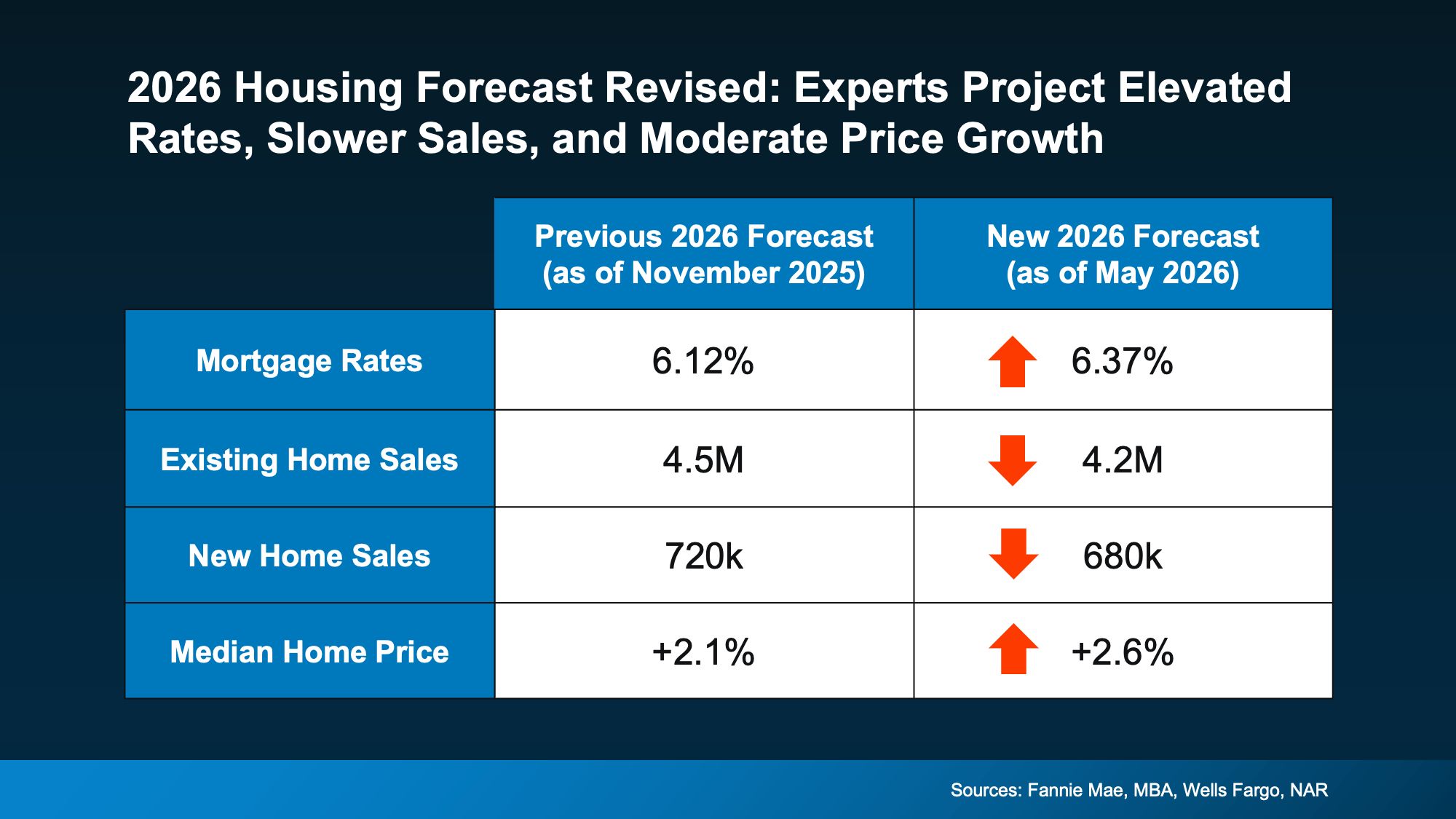
To understand where we go from here, it helps to look at how national real estate experts have revised their projections for the second half of the year. Keeping Current Matters highlights four key trends adjusting nationwide:
Rates Will Likely Stay in the Mid-6s: Hopes for interest rates dropping into the 5% range this summer have faded due to sticky inflation. Most major housing organizations now project rates will remain elevated in the mid-6% range through the end of 2026.
Sales Volume Revised Downward: Originally, experts forecast 4.5 million existing home sales across the country this year. Because of affordability constraints, that has been dialed back to 4.2 million. While slower than expected, it is still projected to outpace total home sales from last year.
Home Prices Are NOT Dropping: This is the most crucial takeaway. Even though sales activity is slower nationwide, experts have not revised their home price forecasts downward. Why? Because overall housing supply is still historically low. Slower demand is matching lower supply, keeping prices stable rather than causing a decline.
Sizable Pent-Up Demand: Chief Economist for the National Association of Realtors (NAR), Lawrence Yun, notes that there is still a massive pool of buyers waiting on the sidelines. The moment inflation settles or geopolitical tensions ease, that demand is ready to release back into the market.
What This Means for You
For Sellers: Precision and Presentation are Non-Negotiable
The days of overpricing a home just to "see what happens" are over. Because active buyers are highly educated and rate-conscious, they are exhibiting intense price sensitivity, especially in high-inventory sectors like DC condos. If a home is priced and staged correctly for its specific micro-market on day one, it will sell. If it's overpriced, the market will reject it quickly.
For Buyers: You Have Real Power (In the Right Places)
If you have been waiting for the market to give you a window of opportunity, this summer is it, particularly if you are shopping for a condo or townhome in the District. You are no longer backed into a corner. Buyers are successfully negotiating on terms, home inspections, and seller concessions (like interest rate buy-downs) again. You have choice, room to breathe, and time to make a smart decision.
The Bottom Line
The mid-year housing market isn’t a story of a slowdown; it’s a story of a healthy calibration. The market has fragmented, creating incredible opportunities for buyers in specific segments, while maintaining strong equity positions for suburban and single-family homeowners.
Because the market varies so drastically depending on your specific street name and property type, navigating it successfully requires data-driven, hyper-local expertise. The Wardman Residential team is here to guide you through the numbers.
Ready to start your journey?
Whether you are looking to secure your first home, navigate the evolving local DMV market, are considering selling to capitalize on your current equity, or are just curious about the value of your investment in your specific micro-market, contact your Wardman Residential team member today to put together a personalized market analysis or action plan tailored to your goals.
Market insights compiled by Wardman Residential using data from Keeping Current Matters, Bright MLS, and SmartCharts.